


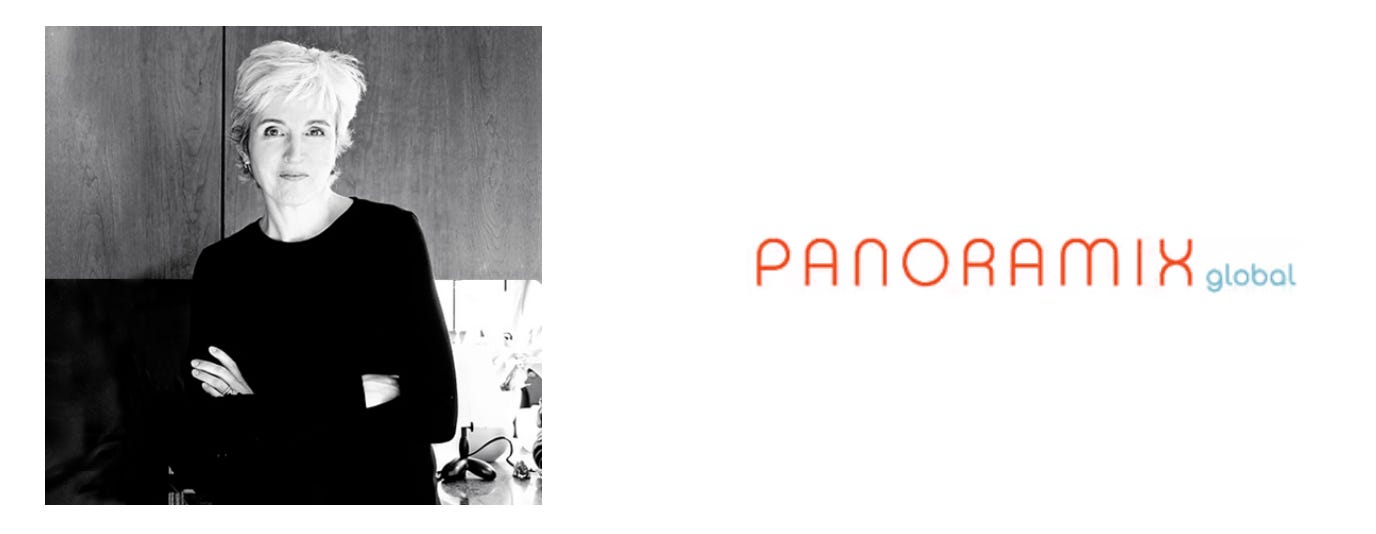
Mary Meehan is a Strategic Cultural Adviser and co-founder of Panoramix Global. Previously she co-founded the consumer trend agency Iconoculture in 1992; and co-founded Metametrix, a text analytics platform for identifying values and emotions, where she served as CEO. She is co-author of *The Future Ain’t What It Used to Be* (Riverhead Books, 1998) and a contributor to Forbes.
So I’m not sure if you know this, but I start all these conversations with the same question, which I borrowed from a friend of mine who’s kind of a neighbor. She teaches oral history, helps people tell their story. And it’s such a beautiful question. I borrowed it slash stole it from her, but it’s really big. So I kind of over-explain it the way that I’m doing right now. So before I ask it, I want you to know that you’re in total control and you can answer or not answer any way that you want to. And the question is, where do you come from?
Great question. I come from a place of curiosity that drives everything I do in my work in understanding what people do and why they do it. That’s my main purpose in all of the work that I do. And you have to be curious in order to be able to really seek out something that’s unusual, that you haven’t seen before, that may be a way to get to know people better or unearth their motivations.
Yeah. When do you feel like you discovered this curiosity? I mean, everybody’s curious in some way, but when do you recall this kind of curiosity became the thing?
Well, I can go way back in time, but it’s kind of a long story. Let’s really show my age as well. It started when the Beatles hit the United States. I was really young. I was fascinated by why these girls were screaming. Why were they fainting? What could drive them to feel something so passionate when they can’t even hear or sometimes even see these celebrities who have come to perform in the United States? And that’s one of the earliest times I can remember.
But all along the way, there are just these moments where I think, why is that happening? What is happening right here with these people in this setting, in this context, to bring this to this point of fame or interest or fad or trendiness or whatever it is?
That’s amazing. Can you tell me a story about that moment and the Beatles arriving?
Well, let’s see. So that was a long time ago, Peter. It was a musical revolution here in the United States. It was nothing that anybody, much less teenagers and preteens, had ever seen before. And it was so exciting and new and kind of free that it resonated with so many people. But the point where you would scream and faint, that’s what I thought: all right, that’s super interesting.
And people do it today. I mean, they don’t faint. But if you look at superfans, that’s also one of my curiosities. What drives somebody to paint their chest blue or wear horns or whatever superfans do at games? What brings people to that point of such fandom, such passion, such commitment to something else, that they are overwhelmed?
Yes. I share that fascination. I’ve seen the footage of Beatlemania, right? And I’ve had that same question watching some of that footage of the girls and young women just really going crazy. It’s really amazing.
Yeah. It was just something no one had ever seen. I mean, there was Elvis, and there were other musicians that were breaking molds and setting new standards in music. But this was something completely different.
Yeah. Where were you when the Beatles arrived?
I was in my little suburban house with my family, just watching on TV. It was Ed Sullivan. And it was watching Shea Stadium and watching them arrive at the airport and all that we could see on TV. And now I’m even wondering, did I see a lot of that on TV, or did I see it retrospectively? But it commanded so much attention and so much criticism, so much passion. It was just so remarkable.
Yeah. And do you have a recollection of what you wanted to be when you grew up, young Mary, in that suburban house? Did you have an idea of what Mary wanted to be when she grew up?
I had no idea. I had no idea. And I went to art school because that’s what I’m passionate about. It’s creativity, really. And there, what you’re looking for is inspiration. What is it that I want to create? What is it that I want to do? What do I envision? And from what I understand, it leads a lot of people to become entrepreneurs, going to art school.
Yeah. And catch us up. Tell us, where are you now? And what are you doing? What do you work on?
Well, a long way from there. But I started a company in 1992 with partners called Iconoculture. And we were a consumer and cultural trend agency, consulted for a long time. And around ‘98, ‘99, we decided to expand the business. And we created an online database of trends and took on venture money. We built a team of writers and editors and strategists that would work with our clients. It was exciting. It was an amazing experience. And the people that I worked with there, they’re just incredibly smart and funny. And I miss them so much. Because in 2010, my partner and I decided to leave, and the business sold.
And I love what I do. And it is building on that curiosity, because our methodology, or kind of the nucleus, the soul of how we approached trend identification, was to look at where people are, what they need, what they’re passionate about, what they want. And we believe, I still do, that that choice that people make in those moments is driven by your values. What is important to you? What is it that you want or need? What are you excited about? And so this idea that values drive trends was far more interesting to us than the trends themselves, although trends are fun and interesting.
But it is that idea, that methodology, I carried over in starting another business, where I continue to do cultural advisory work. And that is helping people understand the bigger picture in their customer’s world that can influence the choices that they make. And I believe that you need to understand that first before you do primary work, because you will be able to ask better questions. You are going to be better informed. You will design better instruments in those moments if you understand all those forces that affect the people that you’re trying to attract.
And it involves curiosity. You have to look at what’s out there, what’s moving, and particularly what’s changing, and why is it changing, that can give you a clue to where it’s going and how people will react to it.
There are two things I want to follow up on. Maybe I’ll just ask the first question, which is, what more can you say about values? Values is one of those, it can be sort of a big mushy word. What do you mean when you’re saying values, and what does it mean to either identify them or learn about them?
Well, I can distinguish two things, values and emotion. So values are the principles that guide us in our lives. And we don’t often think about them. We sort of take them for granted.
But I saw a really interesting video, a podcast, where Adam Grant, the professor, was a guest. And he said that he performs this experiment whenever he works with students, asking them to recall a time when they got angry. And he asked some people to talk about it and explain what they thought about it, how they felt. And he said, your anger is a reaction to your values being violated. If you think about it, it makes complete sense. Because if you’re disgusted by something, if you’re angry, if you’re sad, you are reacting to something that is out of whack with how you normally think or feel or behave.
And so it was with that that I continue to think about values as these guidelines that we live by, and comparing values to emotions then. Emotions are a psychological response to something that we experience. It’s more momentary, where values are kind of longer term.
Now, I’m simplifying this greatly. If there’s any scholars listening, they’re going to argue with me. But just for the sake of our discussion, that’s what I believe. And I believe I’m right. So it is a way of understanding people other than just asking people what they think or asking them to rate a question on a scale. It is an additional and, I believe, helpful way to understand people.
Yeah. Well, I’m here for all the nuance, to dig a little bit deeper, if there’s more that you want to share about it. I’m curious about how you identify them or measure them. How do they become something that you tracked? I loved what you said too; so much of this I’m enjoying. There’s the trends. It’s one thing to know about the trends, which are interesting, but your real interest is what’s happening underneath. So maybe tell me a little bit more about that. I’m using underneath as a metaphor for the values, right? But tell me more about how you get in there and what you do with the values, how you get them, how you measure them.
It came from a lot of experience, actually. At the time when we were building Iconoculture, we developed what we refer to as macro trends, and they were kind of a collection of behaviors that reflected a certain set of values. And that’s kind of how we continued to build our understanding: whenever we would observe something, we would slot it into one of those macro trends, because the values aligned, like around safety or something.
Many different experiences or products that you can engage with can be very different in the category they exist in, or the reason for buying, or demographic groups, et cetera. But if they all center around this idea of safety, just as a for-instance, that’s where you can look to understand that that’s what matters to people. And then anybody can build on that. It’s not just the Ring doorbell people; anybody can build on that. So it was a lot of experience.
And when my partner and I left Iconoculture, I had also wanted to see if I could productize that idea, that belief, that methodology. And so I created Metametrix, which is a text analytic platform that can ingest unstructured data and identify the expression of values as well as emotions and themes and sentiment, et cetera.
But the unique thing about this approach is that we have a standard set of values and a standard set of emotions. So every time data comes across our library, so to speak, it measures it against the same set. So we’re standardizing that approach, and it’s math and science that does this. So it’s not just me saying, I think it’s safety, or I think it’s belonging, whatever it is. So we’ve been really excited about that. It’s new on the horizon for a lot of folks out there.
Yeah. What do you love about the work? Where’s the joy in what you do, for you?
It’s the discovery. When you hit upon an insight, it’s just that little dopamine hit. It is that way of thinking, oh, that makes total sense, that that’s what’s going on here. So it’s synthesizing information, pushing against something, pressure testing, et cetera. And when you find it, you think, ah, why didn’t I see this earlier? It’s that little bit of, I don’t know, joy that comes from that.
Yeah. Can you say more about what happens in that moment? Maybe I’m asking about, we talk about insight. There’s this trouble when we try to name something, we kind of kill it, of course. But I’d love to hear what you’ve learned over the years about either the conditions to make that happen, or how do you know that it’s real when it actually happens?
Yeah. You’re right. You’re right. It’s a very squishy area. And that’s why the work that I do is on that fuzzy front end, and it’s called that for a reason, right? Because it’s meant to inspire people. Like, when you start to look for these things, think about this, keep this in mind as you’re doing your work that is more measurable. Because my text analytic engine can measure. So when people are writing, or transcribed speaking, you can measure it.
But if it’s just me looking at the world, collecting information and saying, with this information, I see your opportunity is X, it is collecting this large digital pile of stuff and then sifting through it and trying to figure out what this means. And I will tell you, I’ve been doing this for a long time. Every time I start in on something like that, it’s not going to work. I’m going to have to go back to my client and say, I can’t do it. I don’t know what I can’t.
And then you just keep working through that gray cloud of uncertainty, and slowly a picture begins to emerge, and it happens every single time. And I can’t dispel it. And I don’t know why, but that’s what happens.
But it is very exciting, because it is your initial assessment of what you’re finding out there. You’re thinking, that’s interesting. That’s interesting. What’s going on there? I want to collect that. Let’s pull this all together. And then synthesizing stuff like this, thinking, oh my God, what am I going to do with all of this? But then it is the kind of reward of pushing through that lump of clay. As you’re trying to mold that lump of clay into something, it’s the effort that then you’re rewarded with. You go, that’s it. That is a really good idea. That’s there.
And I can substantiate it by tying it back to these other areas. So it’s not just one thing that looks like, oh, this brand, this company, this organization would benefit from knowing this. It’s, can I substantiate it with other observations from the world, other statistics, other reports, other commercials sometimes?
Yeah. When did you first discover that this is something you could make a living doing? I mean, you were at art school, right? So you went to art school, and then somehow you’ve ended here. Maybe connect those two dots. When did you discover you could make a living doing this?
Well, I had wandered in the wilderness for a bit, and I worked in retail, and I worked at this incredible retailer called Dayton’s. It’s really well known in the Midwest here. And I worked in the stores, and then I worked in merchandising. And then I was asked to start this other department called product development, in the marketing division. And I had an incredibly brilliant boss. And my job was to figure out how to get people into our store the day after Thanksgiving before they go somewhere else, because then they will spend their time there shopping.
And so with my boss’s help, a really bright, brilliant man, we created this character. I won’t go into it, it’s a long story, but it was a huge success. And I started thinking, okay, why did people want that? Was it just because we priced it right? Was it the shape of this thing and how soft it was? What was it? What was the character? It was called Santa Bear. And it was a stuffed bear that was at this low price that day. And so I worked with other buyers at the store, who were just these incredibly great people, to make T-shirts that had the character on it, and coffee mugs and nightgowns, et cetera. So when you walked in the store, there was a display, and it was unique. And we went on to do a lot of things, but anyhow, that’s where I kind of got the bug for it. And so many people did that; the work around that character and that success wasn’t just me and my boss, it was a lot of people.
So then, in retail at the time, this is in the late eighties, and particularly in a department store, you work within an organization called AMC, which is a global buying group that you are a member of. And they would send us trend information, like silhouette and color, and it was on mimeographed sheets. And I thought, oh, that’s really interesting. It’s really helpful. The buyers really depended on it, and it was really good. They did a great job. But I thought, but why? Why would people want this color or this silhouette?
And so when I left there, I wandered in the wilderness a little bit again. And I thought, why isn’t there a report for trends, of what people are doing and why they’re doing it, which is how I think about trends? And I called my friend, Vickie Abrahamson, who is this fantastic person. And we had lunch, and I said, hey, would you want to do this trend business? And she said, sure. Okay. That’s what we did. That’s how it started.
And it was about looking at unusual occurrences, things that people were doing, and trying to understand why they were doing it. And it was a newsletter. It was printed on paper, with stamps. Then it evolved, of course, because with the advent of the internet, we gradually moved ourselves online. And all the while we were consulting with companies, doing this kind of work, but the newsletter was this marketing effort, really.
I mean, when we talked before, I remember Iconoculture, and I’m not sure how long it was going on, but I remember getting the email format and the report. And so I was super interested to talk to you about it, and you hinted at it already, about how you think about and define trends. So maybe I’ll just ask that question: how do you think about what a trend is? And I came up a little bit as a researcher, a little suspicious of trend talk and fad talk, and probably critical of it, probably unfairly critical. But what’s the case for trends, and what do you mean when you’re talking about what a trend is, or why it matters?
I’m glad you asked that, because it’s a super fuzzy area. And the thing that shocked me was when Vickie and I left Iconoculture and went out on our own, I kind of looked up finally after building this business. And I was shocked at the number of people who were trend spotters. And it was disheartening, because I think of trends as evidence of a change in the culture. They’re often interesting, and kind of fun, some are kind of wacky, but it’s really important to use trends as a tool, as a clue to what’s going on.
And with Iconoculture, thanks to Vickie, who really helped make it kind of this fun brand, we had a really interesting, kind of provocative approach to it. But we took it very seriously, in that it was important to think about understanding that people don’t always do what they say they do. And so by watching people, by collecting information from the culture, you can also learn about them from that perspective. Then you can go ask them what they think, because we all know that the answers that you get will not always be true, or it can be a bad day for them; all those things are true.
And so I agree with you. The people that were trend spotters, they got ridiculed on late-night TV. I mean, it was all over. So I totally understand, and I think it’s valid, but I have my own point of view.
Yeah. Well, it reminds me of, are you familiar with Grant McCracken?
Oh yeah, sure.
So I’m a superfan of Grant, and he talks about fast culture and slow culture. And I feel you talking about the slow culture when you’re talking about values, right? Trying to understand this stuff, that trends are an actual change in culture, is what I heard you say. And I appreciate that. Because I feel like the critical take on trends is it’s just like a hype cycle, right? Or, I’m not trying to put words in your mouth.
No, no, no. I think you’re right. First of all, hi to Grant, if he’s watching this, hearing this. I really respect his work, and whatever he sends, I read. So thank you, Grant.
And I can’t remember what he meant by fast and slow culture. And I always get fast and slow thinking mixed up too, because I believe in both of those things; both are true. People use that terminology to describe different ways that people think. And I would say that values are more, if you’re thinking about guiding principles as I defined them, right, values are slower. They exist throughout your life. They may reprioritize at different times in your life. Like if you go to grad school, your priorities, your values are going to be, or you have a baby, right? Your values really shift, et cetera.
But emotions are more transient. They are an immediate reaction to something. Now, it’s not like they immediately go away. I don’t mean that. And I know if there’s any neuro people out there, I know that more takes place in your brain than just that. But it’s an easier way to understand these two elements that are kind of readily available, so to speak, in our world, that can help you understand people and what they’re doing and why they’re doing it.
But to Grant, he has come up with some really interesting maps, as I recall, too, that now I can’t remember what they were, but.
No, but that totally aligns with what I was thinking. That’s exactly why I mentioned it, what you’ve just described about values as slow. I’m curious about the name. It’s such a good name, Iconoculture. Is there a story behind it?
Well, let’s see. I’m going to credit Vickie with that too, because she was really good. You know what? I can’t quite remember how we did it, but it was about understanding, well, because within understanding values, there’s an anthropological approach to it. There’s a semiotic approach to it. There’s behavioral science; all of that goes into it. So semiotically, it’s those icons that you’re looking at, often, that establish something, and then the culture kind of mixed with it. I think we just made up a word.
This is the selfish part of the conversation, where, as somebody who makes a living in face-to-face qualitative research and ethnographic stuff, I’m always wondering, what’s your sense of it? How do you use it or not use it? Is there a proper role for it in your work, or not? Or if not, how do you learn? What’s your research? What’s your methodology?
Oh, yes, absolutely. I’m not a primary researcher, although I sometimes get asked to do some of that, which I like, and I join. It’s great. I often get contracted by larger research organizations where their client is looking for something like what I do. Like, they want to understand trends, or they want to understand the culture, bigger picture, et cetera. Then I get called in to do that piece of it. And I work with the primary researchers, and it’s always so interesting, because it’s a great exchange of ideas.
And I believe that the combination of those two things can be very powerful when used correctly. And there’s people that like to work in teams, like I do. It’s a really good experience, not only for the research company that brought me in, but the client too, because they get the benefit of a lot more thinking.
Yeah. And if a client comes to you and asks about qualitative or quantitative, either of those kinds of primary research, what kinds of things do you say to them about it?
I can recommend some amazing people, because there’s some amazing researchers out there. I’m not the one you would go to for that.
Oh yeah. Well, I’m just curious, from where you sit, what is the value of qualitative? What’s the proper role of qualitative? What does it bring? What do you appreciate about it? What’s the proper use?
Sure. So, as I mentioned earlier, I’m the big-picture type of researcher. Okay, so I’m holding up my hands kind of outside our screen here. Look, you’ve got to start out here, right? You’ve got to understand what’s happening in society and economy and in the environment and politics, et cetera. And then within those categories that are related, many different categories that are related to the client’s work, right? So I’m way out here.
Then I move my hands in closer to say that with that information, that’s when the primary work should begin, in my opinion. Because that’s when you are ready to engage with them where they live, because you understand more about what has led them to where they are and how they may answer or may not answer. You can bring different kinds of questions into that face-to-face, whether it’s focus groups or IDIs, or even if it’s an online focus group. The moderator has much more information with which to continue to probe that group.
Yeah. What else can you say about what happens in, I’m mimicking your hands, the space between? You described starting out really, really broad and then getting narrow. Can you describe in more detail what happens in that space? What are you doing?
Okay. I’ll give you an example. So a big research firm, this group that I love, came to me, and they had a client that was working in, I guess, kind of the home and personal care area. And they were interested in developing a piece for their retailers, kind of a thought piece, work that they could share with their retailers to continue to build that relationship. And the researcher wanted me to start with this effort around the idea of aging. It was this new territory that they wanted to take the retailer into.
So when I look broadly, I look at those big STEEP factors, like society, technology, environment, et cetera. And then I also look at what’s happening in music, what’s happening in fashion, what’s happening in health and wellness, what’s happening in sexuality, what’s happening in family, et cetera. So it’s those other categories that aren’t specifically aging, but they are related to aging, because you can find understanding within those categories about how people are thinking about aging and how aging is changing.
And then I worked again with the primary folks there, an amazing team, and just put together this incredible piece for the client, because it had so much information. That’s how it works.
Yeah. That’s amazing. I want to maybe just talk about the state of things now. What kinds of things are you working on now? What are you excited about?
Well, I have kind of two ways of thinking about AI. You knew we were going to get to AI, right? So with my text analytic engine, AI is our hero. It’s just done incredible things for the work that we can do. And then with my cultural advisory work, it’s just kicking my butt, because clients in that world, many of them believe, well, I can just ask AI and it’s good enough. And it’s really hard to hear those words, good enough, because I know the kind of quality that I can deliver.
And at the same time, I understand their needs. I know that budgets are getting tight there. They have not as many people on their teams, they have less budget, et cetera. So I understand. But it just means the people like me, our world just gets smaller.
Yeah. What kinds of conversations have you had with people about AI and its impact on this corner of the world?
Well, everybody kind of says the same thing. So I don’t feel too alone. How about you, Peter? How about you?
Yeah. Well, we had this conversation. I have more questions than answers. I suppose it’s not exactly pessimistic, but maybe it is. Maybe I’m just feeling particularly optimistic right now. I want to say ambivalent. Yeah, I think it’s just a mystery, really. Like to your point, I think the temptation of easy answers and good enough is almost impossible to compete with.
Yeah, it is. It’s hard to compete. And I soothe myself with my text analytics business, because even when we do projects for clients, if they want something custom, I still get to apply all my insights ability to it. I can’t resist. I mean, I could just let it go as it is, but I always like to get in there and make sure everything is accurate and interesting, and the insights are what they should be, and where else we should be looking that whatever our technology is doing for us may have missed or didn’t find.
Yeah. As you look around out there, sometimes I ask this question about envy. Do you make an envy list? Do you see people doing things or work that you would really want to do, or people doing things really well, that do inspire you?
Yeah. I already aged myself by talking about the Beatles hitting American shores. So it’s no surprise that I see young people entering the field in many different areas, and I am envious of their energy and their willingness to try new things. However, I rest on my wisdom, because I know I have it, and I work with a lot of different people in imparting that. So it’s rewarding in that way.
Yeah. Well, I think that’s the sort of, it’s not exactly a silver lining, but if there is optimism for me in this moment around AI, it’s that, at least based on my understanding, it sort of averages everything. So everybody using AI is getting access to the same pool of mediocre, mainstream, averaged ideas, and it creates real opportunities, theoretically, at the fringe, or at the strange, or at the weird, or at the outlier, at the wisdom, you know what I mean? That we, as older elders, there is a logic that says we should become more and more valuable than ever before.
Yeah. Because I think it really depends on what you then do with that information. That’s a big differentiator. And if you’ve got a ton of experience, that makes a difference.
That’s right. Maybe this is a great question for you as a trend person. You see this language; so much of this happens in language. How do you feel about words and language, and what role does language play in how you think about macro trends or trends or values and stuff like that? It’s huge. So I see the word discernment all the time now. And I had never seen anybody talk about discernment, and taste, I think, maybe as a version of it, but it’s sort of held up as the thing that humans have that AI can’t take. And so I suppose I’m just laying that down in front of you and wondering what you think of it.
Well, let’s see where to go with that. First of all, language is absolutely fascinating. Just fascinating. Linguistics and semiotics are probably what I would have studied. And, well, there were probably other things that I would have studied too, but.
I like that you couldn’t allow yourself to limit it.
Right. Can’t. In building the text analytic business, language was just so frustrating, because language, particularly English, is so difficult. Words mean so many different things, and they mean different things in different contexts. So it was a frustrating yet really interesting challenge, because you really had to think. It’s like writing: whenever you write, you have to really think about what it is you’re trying to say, and, because it’s language also, how am I going to put these words together to make sense of it?
And then in building our libraries that analyze all that text, you are going back and forth so many times, trying to correct something, move it around, change the context for it. It’s incredibly painstaking, yet important, because words matter, as we all know.
Yeah. This is a question I often ask, and for some reason it comes together. Were there any mentors that really played a significant role in shaping your work? And then the second half: any touchstones that you return to over and over and over again? In my own work, I’m thinking selfishly, there are ideas or concepts that I constantly revisit. I’m just wondering, do you have any mentors or touchstones that are significant?
You know, when Vickie and I started our business, I didn’t even know what mentors were. And we were women as well. It was hard to find somebody to be a mentor in this business that didn’t really exist, you know? And so we relied on each other, and partners really matter in those worlds, when you’re trying to build something. So I wish I did.
I mean, when I was working at Dayton’s, it was my boss that was this incredible inspiration. And then, moving into this other area that was yet to be something, people just thought we were these trend girls. Like, okay, well, sort of, but what do you do with that then? And where would I go for advice? Who would I talk to? I can talk to lawyers for legal stuff. I can talk to our accountant, but it just wasn’t even a thing then, really.
Yeah. I’m almost a little embarrassed about the question, because I guess to some degree it’s some privilege of mine to have fine mentors and be surrounded by potential mentors, which overlooks how pioneering you were, right, in trying to do this thing at that time. What can you share about what that was like? The struggles and the joy, as it were.
I made some colossally stupid mistakes. It’s painful to think back on some of the stuff I did, and I don’t know that there’s any way around that. And I think entrepreneurs just come away from it. I know there’s a lot of the college dorm room successes, and they just go on to be celebrities. Great. That’s real. It happened. But there are so many of us out there that are just a couple of steps forward, three back. And you’re just on your back. You don’t even know what to do next, but you do. Then you do something and you move forward.
And yeah, I’m not even sure what you asked. It just touched off a nerve, talking about how hard it is. But I can’t do it any other way. I don’t regret doing it at all.
Yeah. Well, I was really thinking about the 80s, 90s. You said trend girls, being perceived as trend girls while you’re building something really, really new, right, and enduring, and how much difficulty that must have been.
It was. And I will say that with the next text analytics business that I created, looking for money was a completely different experience. There are women angel groups out there, and they are so supportive. I nearly cried standing up in front of them telling my story, because you could feel how different it was. You could feel that they were thinking, yes, just go do your thing. What a shift in, I guess it was probably 20 years. I don’t know, I can’t even remember. But very different.
Yeah. Amazing. Well, listen, this has been such a pleasure. I’m so happy to have met you, and I really appreciate you accepting the invitation to just come and join me for a conversation. So thank you so much.
It was a pleasure, Peter.


